If you want your treadmill to last, there is one maintenance task you absolutely cannot ignore: lubrication.
Modern search algorithms and readers alike value one thing above all else—getting straight to the point with expert, hands-on advice. You don’t need a history lesson on the invention of the treadmill; you need to know how to stop that annoying squeaking noise and prevent your motor from burning out.
Treadmill maintenance can feel intimidating, but lubricating the running belt is actually a quick, 10-minute job that can save you hundreds (or thousands) of dollars in repairs. This comprehensive guide covers exactly how to lubricate a treadmill, what oil to use, and the warning signs that your machine is desperately dry.
Why Lubricating Your Treadmill is Non-Negotiable
Every time your foot strikes the treadmill belt, it presses the belt down against the stationary wooden deck underneath. Without proper lubrication, this creates immense friction.
Here is exactly what happens if you neglect to lube your machine:
- Motor Burnout: High friction forces the treadmill’s motor to work twice as hard to keep the belt moving. Eventually, the motor or the motor control board will overheat and fail.
- Premature Belt Wear: A dry deck acts like sandpaper against the underside of your running belt, causing it to fray, warp, or snap.
- Excessive Noise: That high-pitched squeaking or grinding sound? That is the sound of your treadmill begging for silicone.
- Jerky Movements: If your belt stutters or sticks when you plant your foot, the lack of lubrication is causing it to catch on the deck, which is a major safety hazard.
How Often Should You Lubricate a Treadmill?
The ideal frequency depends entirely on your usage, but a general industry rule of thumb is to lubricate your treadmill every 3 months or after 40 to 130 miles of use (whichever comes first).
Here is a quick reference table to help you determine your maintenance schedule:
| Usage Level | Average Time on Machine | Lubrication Frequency |
| Light Use | 1–3 hours per week | Every 4 to 6 months |
| Moderate Use | 3–5 hours per week | Every 3 months |
| Heavy/Intense Use | 5+ hours per week (or multiple users) | Every 1 to 2 months |
| Walking Desks | 10+ hours per week | Every month |
Pro Tip: If you keep your treadmill in a garage or a climate-controlled room that runs dry, you may need to lubricate it more frequently, as silicone oil can evaporate faster in harsh or dry temperatures.
Choosing the Right Treadmill Lubricant (Warning: Put Down the WD-40)
The fastest way to destroy a treadmill is to use the wrong lubricant.
Never use standard WD-40, household oil, or any petroleum-based lubricant. Petroleum products will rapidly degrade the rubber and synthetic materials of your walking belt, rendering it useless.
What You Should Use
You need 100% silicone treadmill lubricant. It usually comes in three forms:
- Squeeze Bottle (Liquid): The most common and highly recommended. It allows for precise application under the belt.
- Spray Can: Easy to use, but can be messy if you aren’t careful. Ensure it is a pinpoint spray, not an aerosol mist that will coat your floor.
- Wax Sticks: Older treadmills sometimes use wax, though this is increasingly rare.
Always check your owner’s manual. Brands like Horizon, Sole, and NordicTrack often have specific recommendations, and using the wrong product can void your warranty.
How to Lubricate a Treadmill: 5 Easy Steps
Ready to get to work? The process is straightforward. Here is your step-by-step guide.
Step 1: Gather Supplies and Unplug the Machine
Safety comes first. Turn off the treadmill via the power switch, and physically unplug it from the wall socket.
You will need:
- 100% Silicone Treadmill Lubricant
- An Allen wrench (T-wrench) or screwdriver (check your manual to see what fits your roller bolts)
- A clean, dry cloth
Step 2: Clean the Deck
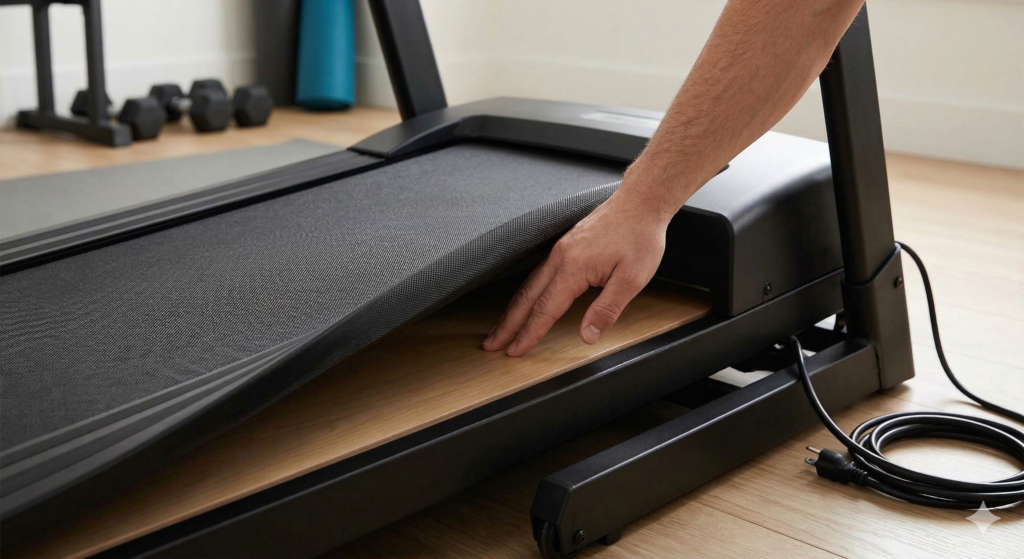
Before adding new oil, you need to remove the old grime. Lift the edge of the treadmill belt and slide a clean, dry cloth underneath. Shimmy the cloth back and forth along the length of the deck to wipe away dust, dirt, and degraded silicone. Applying fresh oil over dirt will just create a gritty paste that damages the belt.
Step 3: Loosen the Belt (If Necessary)
Try to lift the belt in the middle of the treadmill. If you can lift it a few inches and easily slide your hand underneath to the center of the deck, you can skip this step.
If the belt is too tight:
- Locate the rear roller bolts at the very back of the treadmill.
- Using your Allen wrench, loosen both the left and right bolts by turning them counterclockwise.
- Crucial: Keep track of exactly how many turns you make (e.g., three full turns on each side). You will need to tighten them the exact same amount later to maintain proper belt tension and alignment.
Step 4: Apply the Silicone Lubricant
Lift the belt on one side. Take your silicone lubricant and reach as far toward the center of the deck as possible.
- Squeeze the bottle while pulling your hand toward the outer edge of the belt, creating a zig-zag pattern or a straight line from the center to the edge.
- Apply about ½ ounce (15ml) of lubricant.
- Move to the other side of the treadmill and repeat the process, applying another ½ ounce.
Do not apply lubricant to the top (walking surface) of the belt.
Step 5: Retighten and Distribute
- If you loosened the rear roller bolts in Step 3, use your Allen wrench to tighten them back up (clockwise) using the exact same number of turns.
- Plug the treadmill back in and turn the power on.
- Set the speed to a slow walk (around 2 to 3 mph).
- Let the treadmill run empty for about 3 minutes.
- Step onto the machine and walk at a comfortable pace for another 3 to 5 minutes. Your footsteps will help press the belt into the deck, spreading the silicone evenly across the entire surface area.
Wipe away any excess oil that may have leaked out the sides with a towel, and you are officially done!
Maintenance-Free and Self-Lubricating Treadmills
Before you start unscrewing bolts, verify what kind of treadmill you own.
Maintenance-Free Belts: Some high-end commercial models (and premium residential lines from brands like Precor or Life Fitness) feature belts infused with permanent dry lubricants. Applying wet silicone to these belts will ruin them. If your manual says “maintenance-free,” trust it.
Self-Lubricating Treadmills: These machines feature an internal reservoir that you simply fill with silicone oil. The treadmill automatically disperses the oil across the deck based on your mileage. For these, your only job is to occasionally check the reservoir levels and top it up when empty.
The “Hand Test”: How to Know if You Need Lube Right Now
If you aren’t sure when your treadmill was last serviced, do the Hand Test:
- Unplug the machine.
- Reach your hand beneath the center of the running belt.
- Rub your fingers against the deck.
If the deck feels waxy or slightly oily, you are good to go. If it feels bone-dry, dusty, or completely smooth without any slickness, it is time to lubricate immediately.

Hello,
This is Safeer Ahmad founder of FitnessGearsHub. I’m an aspirant fitness freak, I commenced my career as a blogger and I opted for “gym and fitness” as my primary domain. As all fitness gears fancy me, I spend considerable time on research before buying one, I believe a health fanatic should be mindful of the product before making buying decision so I’ll try my level best to provide you ample information to buy one or maintain your gym equipment.